
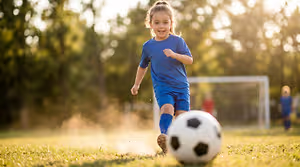
A fast pass crosses the field. A baseball leaves the pitcher's hand. A swimmer reaches for the wall. Young athletes ask a lot from their eyes in a matter of seconds.
For children who play sports, clear vision supports more than seeing the scoreboard. It helps them track movement, judge distance, follow teammates, and coordinate what they see with how their bodies move. At Miamisburg Vision Care, our pediatric eye exams give parents a closer look at the visual skills their children use at school, at home, and during competition.
Why Young Athletes Need Clear Vision
Sports place different demands on a child's developing visual system. Soccer players scan an open field. Baseball players follow a pitch. Basketball players shift their attention between teammates, defenders, and the hoop. Children also spend hours moving between classroom work, screens, outdoor activities, and sports.
A standard eyesight test tells only part of the story. During a comprehensive eye exam, our eye doctor can assess distance and near vision along with visual skills such as focusing, tracking, peripheral vision, binocular vision, and hand-eye coordination. These skills help children gather visual information and respond to the action around them.
What Visual Skills Matter in Youth Sports?
A child can feel comfortable with their eyesight while still having a visual concern that deserves attention. Children have little basis for comparing what they see with someone else's vision. Parents may notice clues during homework, screen time, practice, or a game.
Several visual skills help children follow the action and respond on the field, court, track, or in the pool.
Distance Vision
Clear distance vision helps an athlete see teammates, opponents, field markings, targets, and balls from farther away. Nearsightedness, also called myopia, can make distant details look blurry.
A growing child's prescription can change over time. Regular pediatric eye exams allow our eye doctor to follow those changes and discuss suitable vision correction based on the child's needs.
Eye Tracking
Many sports depend on the ability to follow something that moves quickly and smoothly. Picture a soccer player following the ball through a crowded field or a batter watching a pitch approach home plate.
Eye tracking describes how the eyes follow a moving object or move accurately from one point to another. Children also rely on tracking when they read lines of text and move their attention across a page.
Depth Perception
Athletes constantly make quick judgments about space. How far away is the ball? How quickly is another player approaching? Where will an object be a second from now?
Depth perception helps the brain judge the relative distance between objects. The eyes work together to support this three-dimensional view of the world. A pediatric eye exam can assess binocular vision, which describes how well the two eyes work together as a team.
Peripheral Vision
Plenty of game-day action happens outside the center of an athlete's gaze. A basketball player may watch the ball while spotting a teammate moving into open space. A soccer player keeps track of defenders approaching from either side.
Peripheral vision provides information from the edges of a child's visual field. This visual awareness helps young athletes stay tuned in to movement around them while keeping their attention on the play.
Hand-Eye Coordination
Catching, throwing, hitting, kicking, and reaching all require the brain and body to respond to visual information. Hand-eye coordination connects what a child sees with a physical response.
That connection also supports many everyday childhood activities, from handwriting to playground games. Pediatric eye care at Miamisburg Vision Care can assess hand-eye coordination alongside other visual skills, giving parents a broader picture of how their child uses vision throughout the day.
Help Your Child See the Game More Clearly
Good preparation for a youth sports season includes cleats, uniforms, equipment, practice, and a clear view of the action. Growing eyes can change, and an updated prescription can support clear sight during sports, school, and everyday activities.
Parents can support their young athlete by:
- Keeping up with regular pediatric eye exams
- Sharing sports-related vision concerns with our eye doctor
- Keeping glasses and contact lens prescriptions current
- Choosing appropriate protective eyewear for the sport
- Encouraging children to speak up about blur, headaches, or eye discomfort
- Seeking prompt care after an eye injury
Some older children and teens may prefer contacts for sports. Our contact lens exams include measurements and testing to help our eye doctor find a comfortable, clear-fitting lens based on the patient's vision and lifestyle.
Eye protection deserves attention as well. Sports can bring fast-moving balls, equipment, fingers, and other players close to the face. Miamisburg Vision Care also provides eye care services for families who need help with urgent eye concerns. Contact our practice promptly when a sports-related eye injury causes pain, redness, swelling, light sensitivity, or a sudden change in vision.
Clearer Vision for Athletes in Miamisburg
A young athlete brings practice, teamwork, focus, and plenty of energy to every game. Clear vision helps them make use of the visual information coming their way, whether they're tracking a soccer ball, following a swimmer in the next lane, or spotting a teammate across the basketball court.
Miamisburg Vision Care has cared for generations of local families since the 1940s. Today, our team pairs those deep community roots with modern vision testing and personalized eye care for patients of all ages.
Give your child a clearer view of the classroom, playing field, and everything in between. Schedule a pediatric eye exam with Miamisburg Vision Care in Miamisburg, Ohio today.
FAQs
How Often Should Young Athletes Have Eye Exams?
- Miamisburg Vision Care recommends eye evaluations at 6 months, age 3, when children start school, and annually after that. Our eye doctor may recommend a different schedule based on your child's vision, eye health, or individual risk factors.
Can 20/20 Vision Still Come With Vision Concerns?
- Yes. Visual acuity measures how clearly someone sees at a set distance. Children also rely on focusing, tracking, binocular vision, peripheral vision, and hand-eye coordination. A pediatric eye exam can assess this broader range of visual skills.
Can Children Wear Contact Lenses for Sports?
- Contact lenses can work well for some children and teens, depending on their eye health, prescription, maturity, hygiene habits, and lifestyle. A contact lens exam helps our eye doctor assess lens fit and discuss options suited to your child.
What Should I Do After a Sports Eye Injury?
- Contact Miamisburg Vision Care promptly, especially when your child experiences eye pain, redness, swelling, light sensitivity, bleeding, or changes in vision. Our eye doctor can assess the injury and recommend appropriate care.